
Gifts and Skills – Week 2
Session 2 Me and God
In the second session we will consider further our relationship with God – how do we hear God, what gets in the way of that process? How can we be more present to God? In this process of ‘discerning our gifts and skills’, how will we understand God’s role in our lives and in our flourishing as talented humans?
Gifts and Skills Week 1
In this first session we will get to know one another and think about what has brought us to this course: while this is a personal journey, for these weeks we will accompany one another in our path of discernment. This is an opportunity to take stock. Where are we in our lives? What engages us, what challenges do we face, what experience do we bring? Over the coming weeks we will be developing our practice of reflection and we will start that process at our first meeting.
Anne Jones: Visit to our nearest mosque

Last Friday night, like many Glaswegians throughout the city, I had a curry for dinner. However, I dId not head for the local take away or restaurant, instead I made my way to the Al’Furquan Mosque in the West End of Glasgow, as a guest of the Muslim community there, invited to join them in their celebrations of Eid. It is their custom to ask their neighbours to a meal on these occasions and their guests included members of the local churches as well as students and other folk who live nearby. St Mary’s Cathedral is their nearest church, which is why I was fortunate to be there.
I had never been to such an event before, in fact I had never been to a mosque before, and although I knew the Provost and another member of our congregation would be there, it was with a little apprehension of the unknown that I arrived at the hall next to the mosque for the meal. Within minutes of my arrival I was completely reassured. Three young Muslim women greeted me with smiles, jokes at each other’s expense, and admiration of the interior of St Mary’s, which they had visited out of curiosity. I was whisked into the hall by two of the women and seated at a table near the door. I was early and the room was almost empty. We chatted, how we chatted, about our families, our backgrounds, my role at the Cathedral and their role at an Islamic Centre in a nearby town. Before I knew it the tables had filled up and the proceedings started.
We were formally welcomed by members of the Mosque, including their President. They spoke movingly of their desire for dialogue within their local community and beyond, to ensure all diverse groups could meet together in friendship, acceptance and above all peace. They drew attention to the standing banners, which were arranged round two sides of the hall. One set was entitled The Celtic Crescent, the result of research by members of the mosque to describe the link between Islam and the Celtic history and culture. The other set described the Five Pillars of Islam, faith, prayer, fasting, charity and pilgrimage, which are the five basic acts in Islam and the mainstay of Muslim life. We were told that the Mosque is open five times a day for the prayer, as prescribed by their faith, and were invited to call in at any time.
The buffet meal that followed was delicious and the hospitality most generous. There were twelve tables with ten people at each table and yet very quickly everyone had helped themselves to the fragrant, appetising dishes. Mmmm, the seekh kabab, chicken tikka, baby potatoes, vegetable spring rolls! Yum, vegetable curry, lamb karahi , pilau rice and naan bread! What a feast, what a celebration! And all round the hall the conversation and laughter continued.
While we ate the dessert we heard a young Muslim academic deliver a talk entitled In the Footsteps of Abraham. He told us that the Eid we were celebrating had links with the Hajj (pilgrimage) to the Grand Mosque at Mecca and spoke sadly of the deaths caused this year when a huge crane collapsed on a crowded square and later when an even greater loss of life occurred when pilgrims were crushed to death in the heaving crowds. He described the importance of the sacred history and worship of the prophet Abraham and in quiet, lilting tones sang from the Koran, telling the story of Abraham and his son, Isaac.
It was then time for thanks from the guests. Members of the Church of Scotland, the Reformed Church, Interfaith Scotland and our provost, representing St Mary’s Cathedral, spoke of their appreciation of the opportunity to meet in this way. Kelvin described how part of our Eucharist includes the Peace when the congregation wish each other peace with a handshake. At this point he shook the hand of the President of the Muslim community and said the words, “Peace be with you”.
We knew from the original invitation that the event was due to finish at nine o’clock but when it got near to this time we were told that if anyone would like to go to see what happens at the final prayers of the day in the Mosque then we would be welcome to go along. At this point one of the young women who had welcomed us invited some of us to join her in the women’s upstairs room while she said her prayers before returning home. She explained that she had not attended the earlier prayers and now needed to catch up. She would say the final prayers of the day later at home. We followed her upstairs to a long, bare, softly lit room, the floor covered in a spotless red and gold carpet with individual prayer mats incorporated in the design. We stood in silence while she said her prayers, kneeling and touching the floor with her forehead repeatedly. She prepared then to go home while we went downstairs to the main Mosque. But as she left she turned back, rushed up to me and two young women guests, kissed us in turn and was gone. It was a moving moment.
Downstairs in the main mosque, chairs had been placed at the back for the visitors while at the front the men’s final prayers of the day had begun. The prayers were chanted and the men went through the ritual of standing, kneeling and prostrating themselves. Throughout this time men continued to arrive and afterwards it was explained that latecomers stay behind to complete the whole pattern of prayer.
The evening over the guests drifted out into the Autumn evening. It was a fascinating evening, over too soon, and opened my eyes to a religion and culture I knew only the basics about. It was privilege to have been there.
And I will never forget that young woman rushing back to kiss me.
Sermon preached on 4 October 2015 by Kelvin Holdsworth
Sermon preached on 27 September 2015 by Cedric Blakey
Cedric Blakey: Theopoly – the God Game
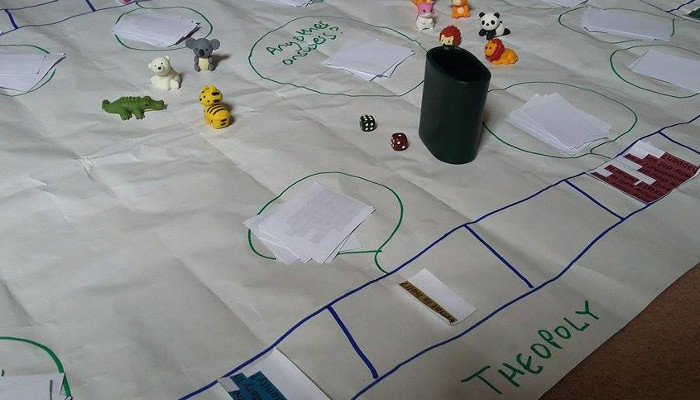
The Vice Provost, Cedric Blakey has devised a game to enable small groups talk about God. In this week’s article explains why he did it and how it works.
I have found an astonishing interest and energy for enquiry about God in Glasgow. The following were just a few of the questions asked by the God Factor course group earlier this year:
- Does God exist? Who created God?
- What does God look like/ feel like?
- Why does God allow and permit evil to exist?
- Is God a man?
- Does God ever change?
How can we initiate exploration of these kinds of questions, and enable discussion about God?
I have devised a game called Theopoly. Depending on the size of the group it can be played competitively with dice, or collaboratively standing round a table. The aim is to achieve, not riches and capitalist property owning domination, but ideas, arguments from a community chest of possibilities.
There is a ‘board’ with squares round the four sides, as in a Monopoly board, and a set of animal characters for participants to identify themselves. On some of the squares are placed the questions asked by the group. Players choose a symbol and in the collaborative version of the game, then walk round the table placing their symbol on the square that most interests them.
By each question there is a set of possible answers, placed upside down on separate squares of paper. Each participant then takes turn to read out their chosen question and to turn over the possible answers, reading them out and retaining the ones that they find helpful, returning the ones that they don’t. Other participants can ‘steal’ any unwanted answer. Participants can add their own answers, writing them on blank squares of paper and adding them to the answer piles.
In a short period of time a great deal of ground can be covered. For instance, the person choosing the question “Does God exist?” last time found five possible answers. The first was “The Bible says so.” Not very helpful, they said. The second answer was “The existence of God is a fantasy, deluded people’s ‘invisible friend’”. There is an interest in contemporary secularism, but so far this response has not been chosen either.
The remaining answers came from other so-called “proofs” of the existence of God: the existence of beauty and love, science, philosophy and personal experience. So we have “Where else could the experience of beauty and human love have come from?” “Scientists who had a belief in God include Newton, Kepler, Kelvin, and Einstein.” “Plato, Aristotle, Immanuel Kant argued the existence of God from the existence of good.” “God has changed my life- some people say.”
In turning over the provided answers participants naturally begin to speak of counter arguments and other arguments in favour. They find a space, standing together around the table to throw in ideas, tell stories and make reference to books, films and personal experience. It is a fast-moving process, once the conversation on a particular subject flags another person takes their turn.
What emerges is a process that enables individuals and the group to speak about God. This appears to be something that folk want to do these days.
Taking seriously questions about God form an important part of our understanding about what people are asking about. In turn this has informed the provisions of other parts of the adult learning experience at St Mary’s, not least the Sunday preaching, the shaping of the liturgy and music, the explaining of the building and its use, and the motto of the congregation “Open, Welcoming, Inclusive”.
It’s wonderful irony of course. For it is impossible to speak about God adequately. And on occasions it is just not possible, or appropriate, at all. And if one tries, it is with great delicacy. What does one say after the Clutha bar helicopter crash? Or the pre-Christmas Queen Street bin lorry tragedy. Or the post-referendum crowd clashes in George Square. What do we say by the bedside of the critically ill and alongside the broken in spirit? And what do we think of within ourselves when faith feels inadequate or is absent. When someone lets us down. Or equally, when we know we have failed against our own standards of being and practice.
This process is not an optional extra to the life of the church, or to any Christian. Speaking about God is one of life’s essentials. In the busy office, the sports centre, bus stop and on-line. How we equip ourselves and others to do it, and to do it authentically is just one reason to try Theopoly.
The game of Theopoly is often played during the God Factor course.
Sermon preached by Kelvin Holdsworth on 20 September 2015
David Kenvyn: From George Square to Elliotdale: How we changed the world

On 18 July 2015, Nelson Mandela’s birthday, a container of 50,000 books left from City Chambers, George Square, Glasgow to be delivered to school and public libraries in the Eastern Cape Province of South Africa. The container was organised by Action for Southern Africa (ACTSA), the successor organisation to the Anti-Apartheid Movement. ACTSA, along with its partner, Community HEART, a British-based charity supporting the development of South Africa, has now sent over 3,000,000 books to South Africa. The container sent from Glasgow helped us to achieve that figure.
The books will go to schools like the one in Elliotdale that I visited when I was in South Africa last year. The local community in Bomvanaland decided to build a secondary school at Elliotdale in 1997, three years after the end of apartheid. They raised the money and they built the school. It now has a library, but there is a problem. They have shelves, desks and chairs, but they do not have any books. There are schools like this all over South Africa.
The first time that I went to South Africa was in 1993, and I visited a school in Soweto. The head teacher, when she learned that I was a librarian, asked if I would like to see there library. I agreed and she brought out a box, which only contained a Latin Bible. This was used to show the children what a book looked like. That is a good example of what library provision was like for black children under apartheid.
Since 1994, and the end of apartheid, there has been a huge investment in schools in South Africa, but there was no magic wand to be waived so that all the facilities required could be supplied, and not just in education, but housing, health, employment, transport, electricity, clean water etc. So some things required international solidarity.
My friend, Kader Asmal, who was Minister of Education in Mandela’s government, spoke to my friend, Denis Goldberg, who was gaoled at the same time as Nelson Mandela, and they agreed that they should ask people in the UK to send 1,000,000 books, and so the book appeal began. ACTSA Scotland, in particular, rose to the challenge and has been sending containers of books on a regular basis since we began collecting books in 1996.
When we were in Cape Town in 2000, Denis and I reported to Kader that the UK had sent a million books, and his reply was “Can you make it 3,000,000?” Sadly, Kader is no longer with us, but I can hear him asking “Can you make it 5,000,000?” now that we have achieved the 3,000,000 target. The need is still there. I saw that for myself last year in South Africa.
So, what has this got to do with the Scottish Episcopal Church, and the Diocese of Glasgow and Galloway in particular? Well, recently, Bishop Gregor convened a meeting to discuss how the Diocese should approach international issues. It was decided that to launch this approach, we needed something that would be a quick hit, and the ACTSA Scotland Book Appeal fitted the bill. The container was already booked for 18th July, and we had to make sure that it was full. So Bishop Gregor wrote to the 66 churches in the Diocese and asked them to send their contributions to Hillhead Library. We had no trouble in filling the container. [In fact, a fair proportion of the next container has now been filled.] The generosity of the donors was extraordinary.
On the day, about 50 volunteers assembled at Hillhead Library at 10.00am to start loading the container. Trolleys were used to get the boxes of books to the foot of the basement stairs in Hillhead Library. The boxes of books were then passed hand to hand up the stairs, into the car park and then onto the container. This took three and a half hours. The volunteers then headed to City Chambers for the official send off at 2.00pm. Meanwhile the jazz band had arrived at City Chambers to set up for the reception. Peter Wakeford organised this. The container and the guests arrived at City Chambers more or less simultaneously. The guest of honour was Obed Mlaba, the South African High Commissioner to the UK. Bishop Idris was there to represent the Diocese, the Depute Lord Provost represented the City Council and their Deputy General Secretary represented the STUC. The event ended with a 17-year old Icelandic baritone, Magnus Walker, singing the South African National Anthem.
This was the first event in which the Scottish Episcopal Church participated following Bishop Gregor’s initiative. The second, the “Glasgow Sees Syria” concert at St. Mary’s Cathedral, has already taken place. There will be more.
Little by little, action by action, we will change the world.